roadhand.app (opens in a new tab) is the decision-intelligence platform for traveling skilled trades workers. Welders, electricians, pipefitters, ironworkers, and the 500K+ tradespeople who drive a thousand miles for a contract. Live, with a paid-host portal already running.
At a glance
- Role. Founder: product, design, and engineering, end to end, with Claude as a daily collaborator.
- Status. Live at roadhand.app. Paid host listings at $199 a year are the revenue model.
- Built. A two-sided marketplace, a wage page for every trade in every state on federal wage and per-diem data, Stripe subscriptions, a content engine on n8n and the Claude API, and a purpose-built design system.
- What it shows. Market choice, product model, UX, engineering, data pipelines, payments, SEO, and content automation, owned by one person.
What it is
The four content types that feed every page:
- Pay Transparency. Workers anonymously report real pay packages: hourly + per diem + OT. Each report benchmarks against BLS median wages so a worker instantly sees if an offer is above, at, or below market.
- Contractor Reviews. Anonymous ratings on pay, safety, management, culture. Paired with auto-generated OSHA safety scores from federal enforcement data.
- Housing Directory. Two-sided marketplace. Workers recommend places they've stayed; property owners list rentals at $199/year. Every listing shows a GSA per diem comparison so workers know if the price is fair.
- Area Intel. Workers rate locations across nine categories: cost of living, housing, things to do, food, safety, cell coverage, weather, people, jobs. Each location gets a composite Road Score from 0–100.
Think Glassdoor meets Furnished Finder, built for the construction industry's 500K traveling workers.
The product, as shipped
Every screen below is the live site at phone width, captured the day this was written. Nothing here is a mockup. The design it was built to is also here, running: open the web prototype →
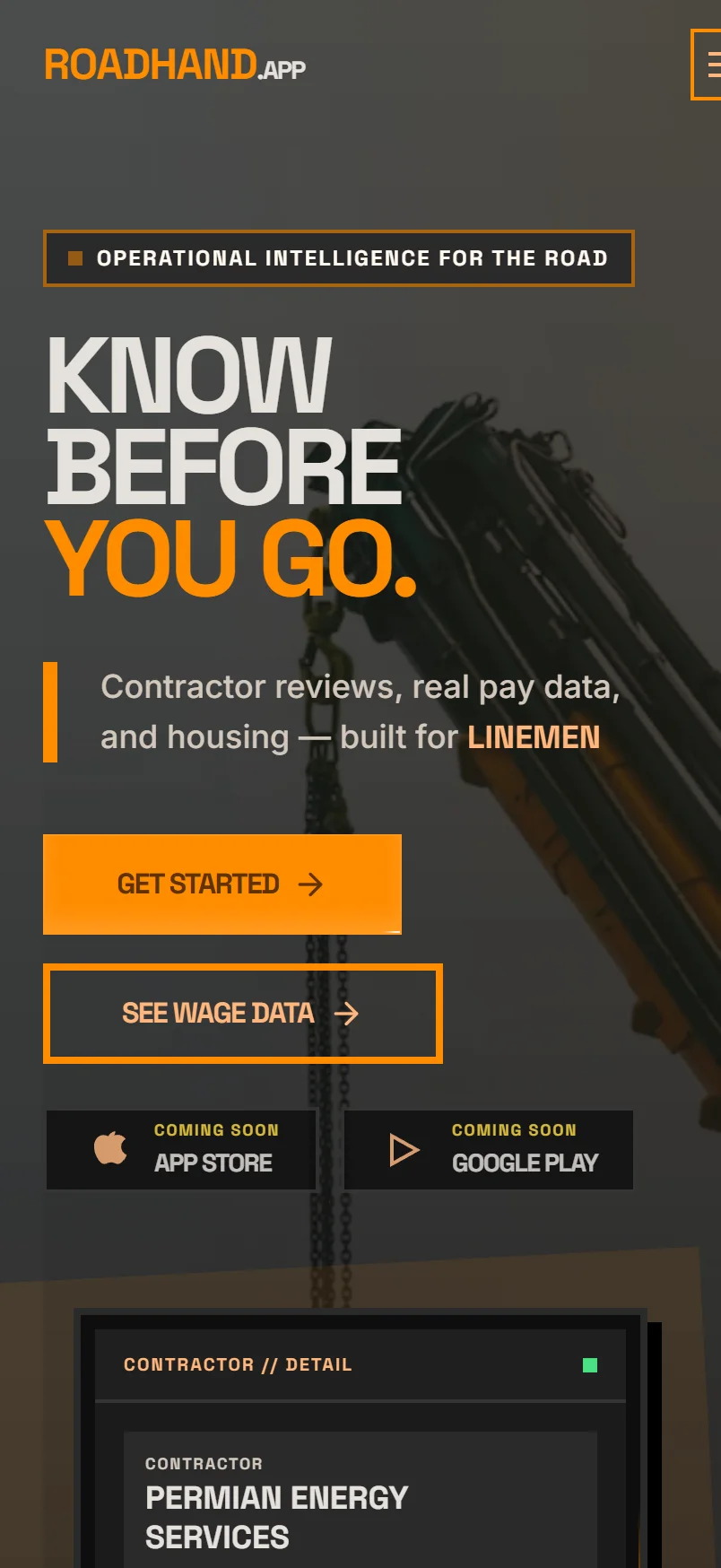
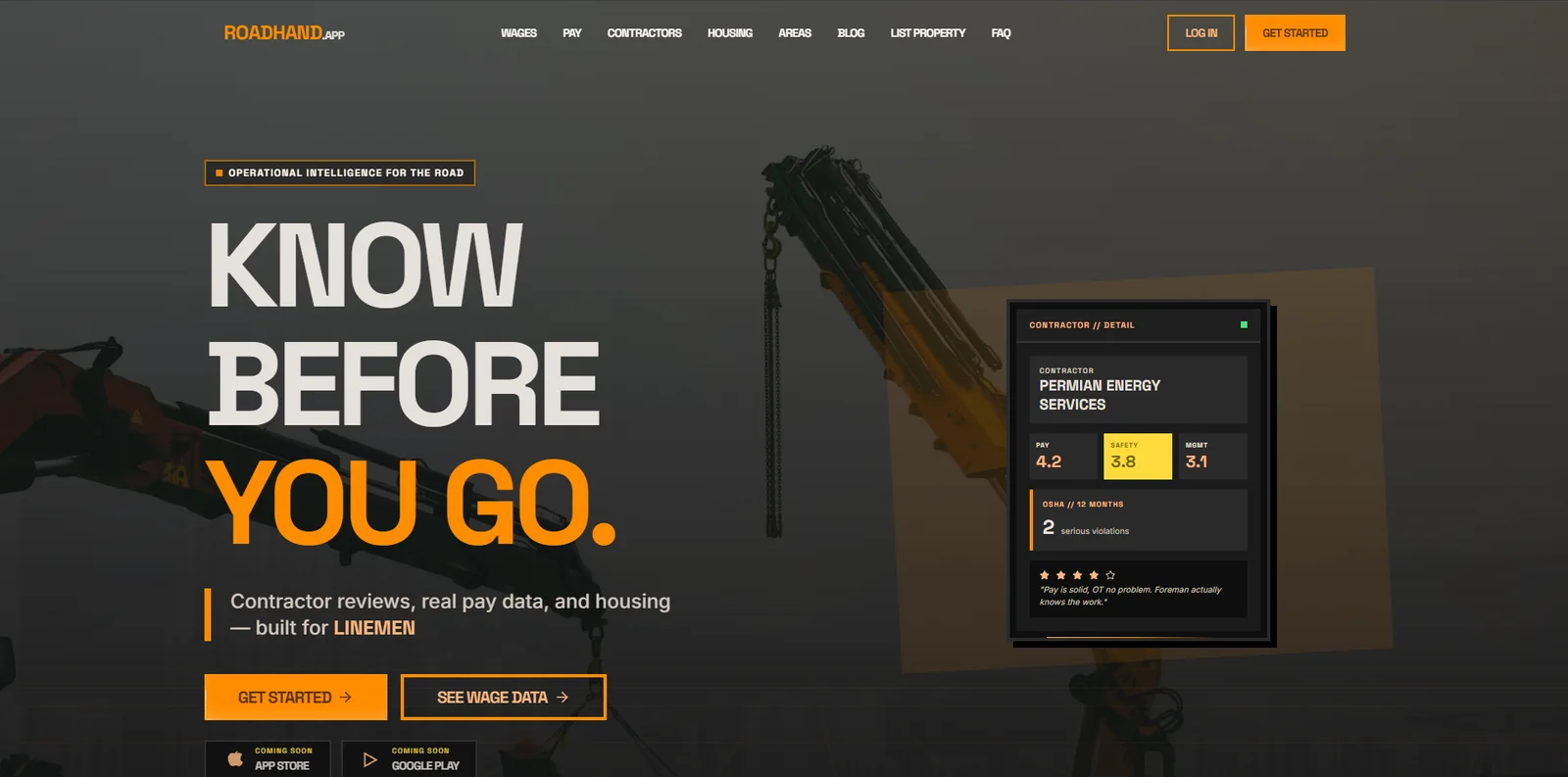
01Know before you go. The trade in the subline rotates; the two CTAs go to signup and the wage data.
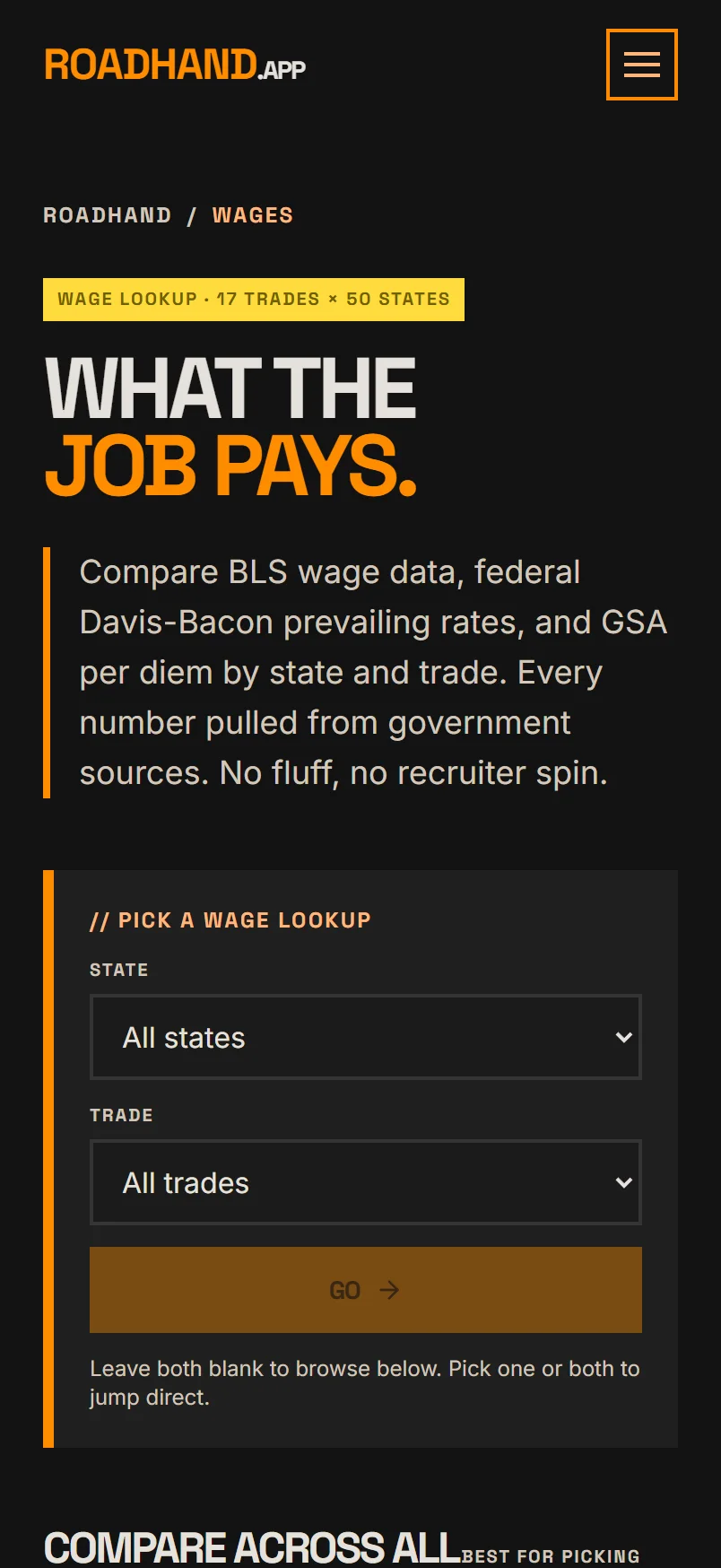
02What the job pays. Seventeen trades by fifty-one states, 270-plus pages behind it.
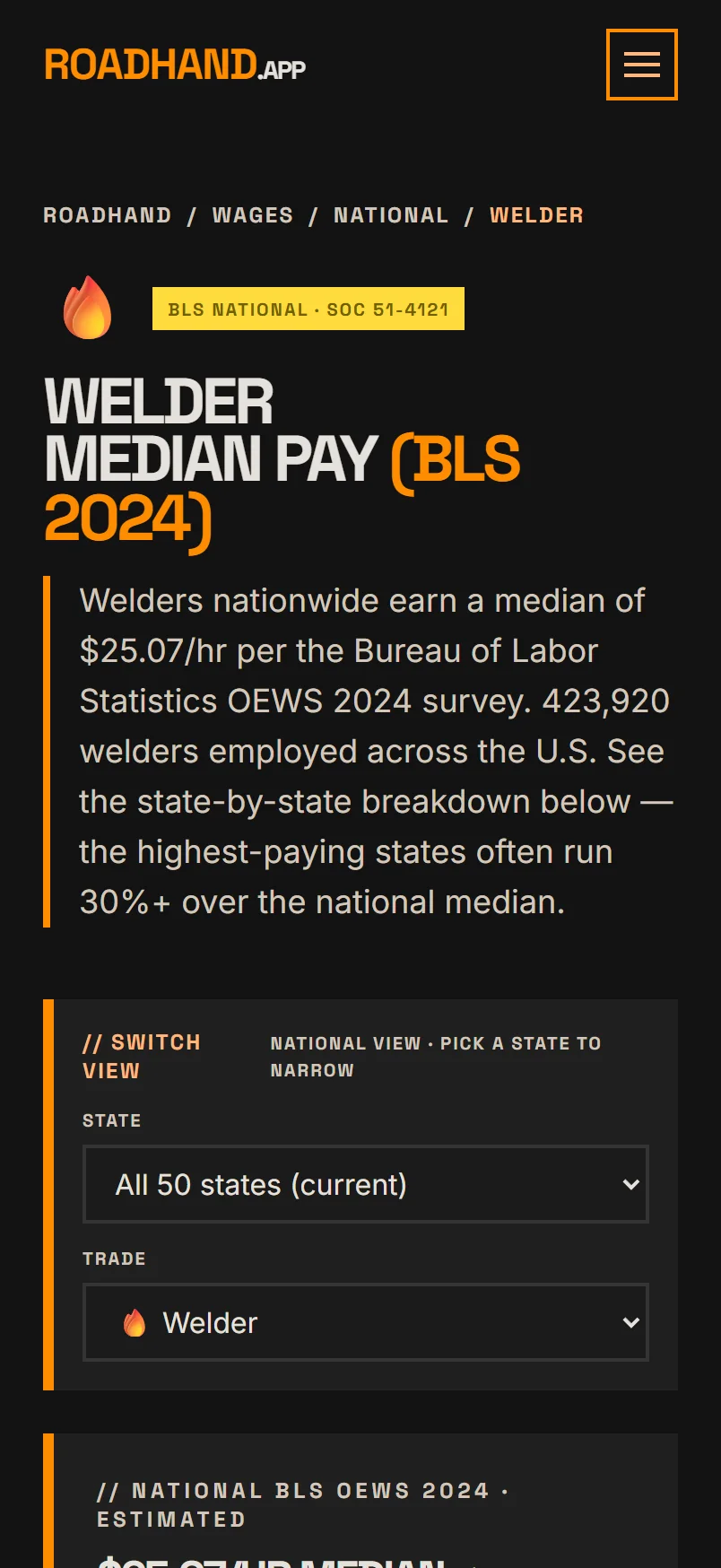
03A trade page. The BLS median up top, a state picker, and the Davis-Bacon determinations further down.
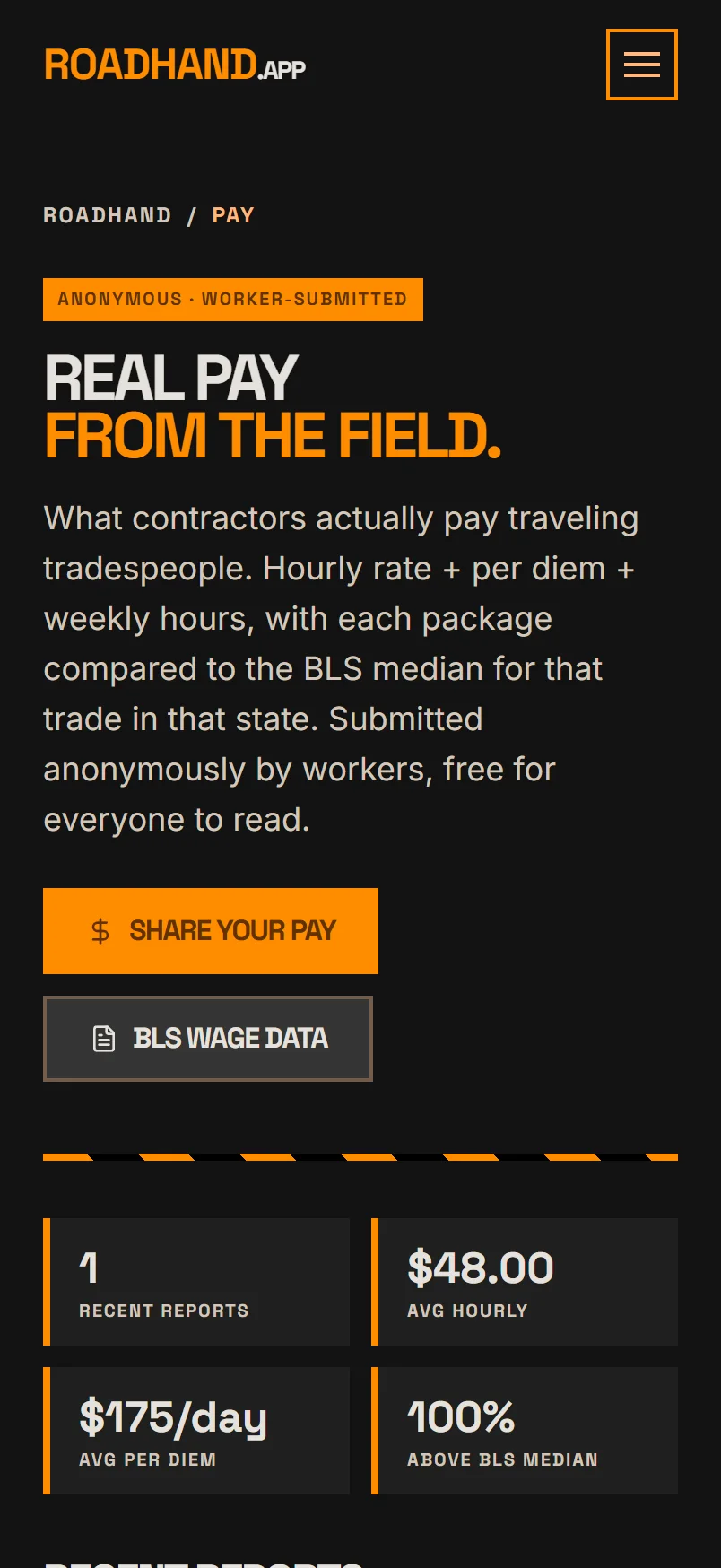
04Real pay from the field. Hourly, per diem and hours, each report benchmarked against the BLS median.
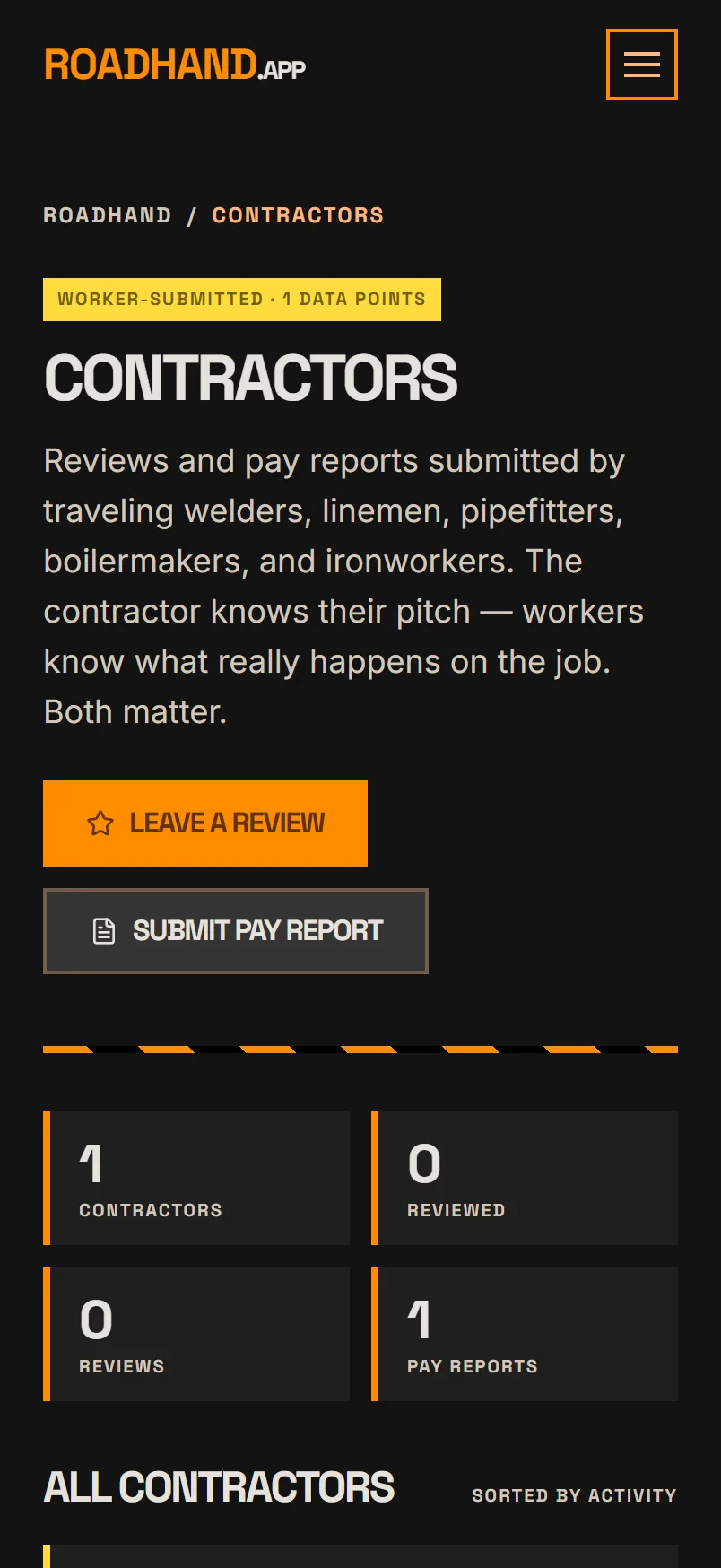
01Contractors. Reviews on pay, safety, management and culture, next to the pay reports that name them.
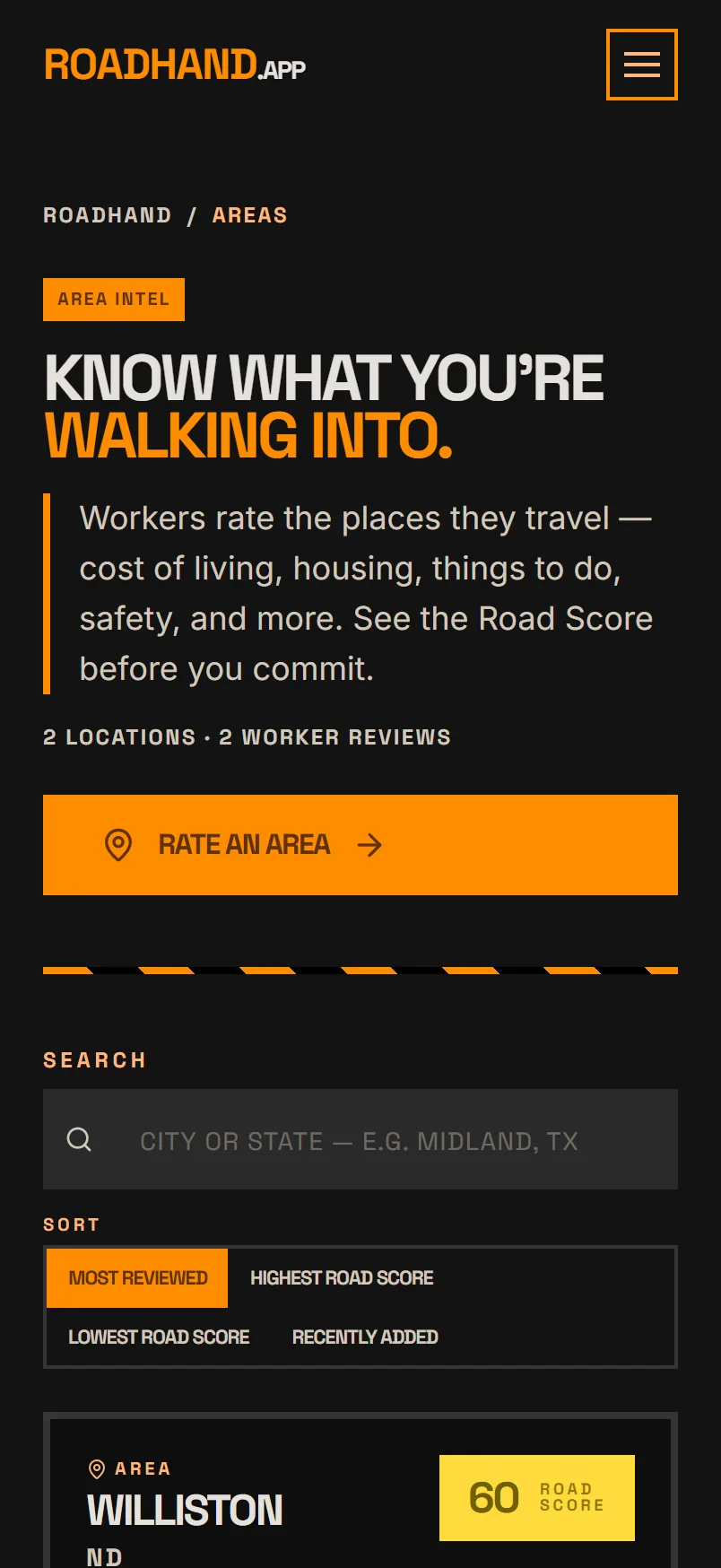
02Area intel. Workers rate nine things about a place; the Road Score sits on the card.
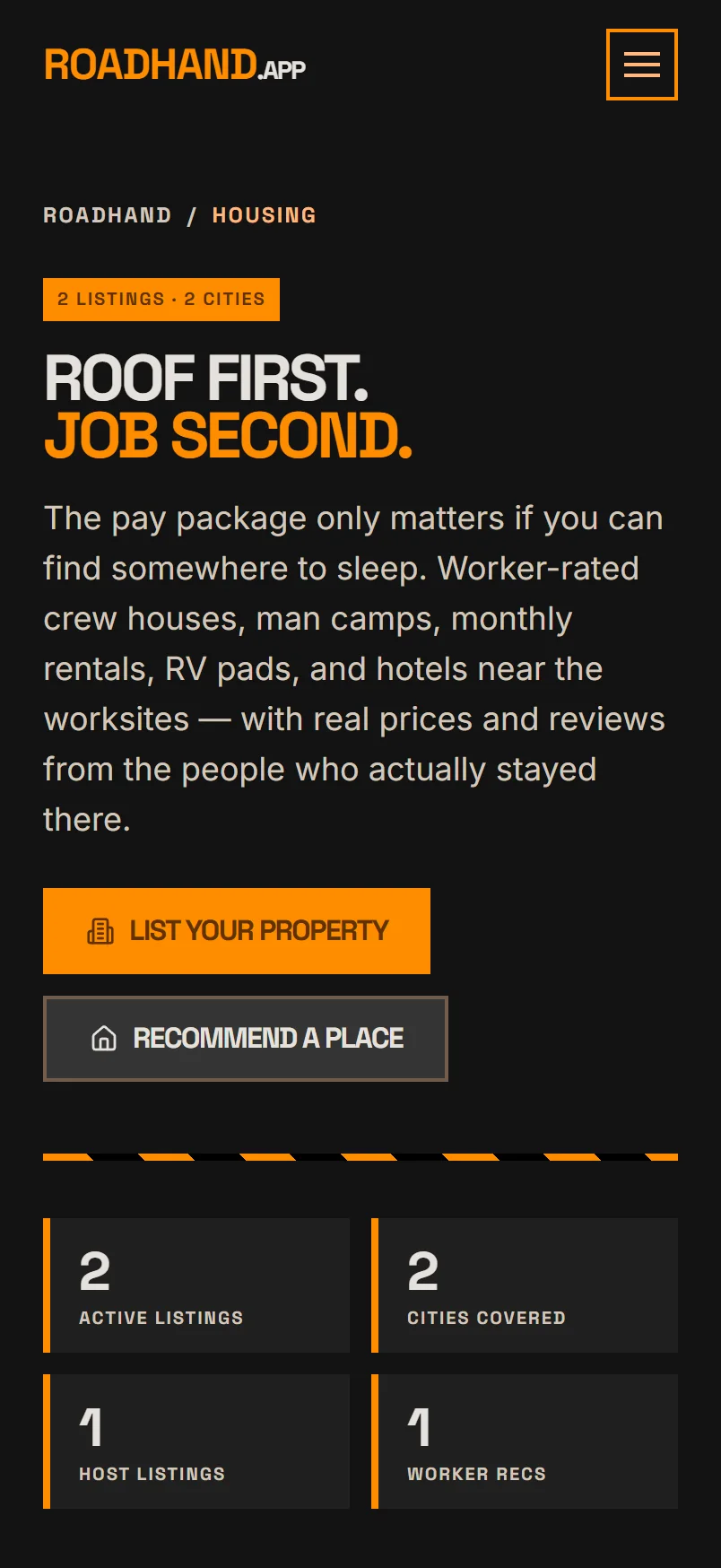
03Roof first, job second. Worker-recommended places and host listings, each against the GSA per diem.
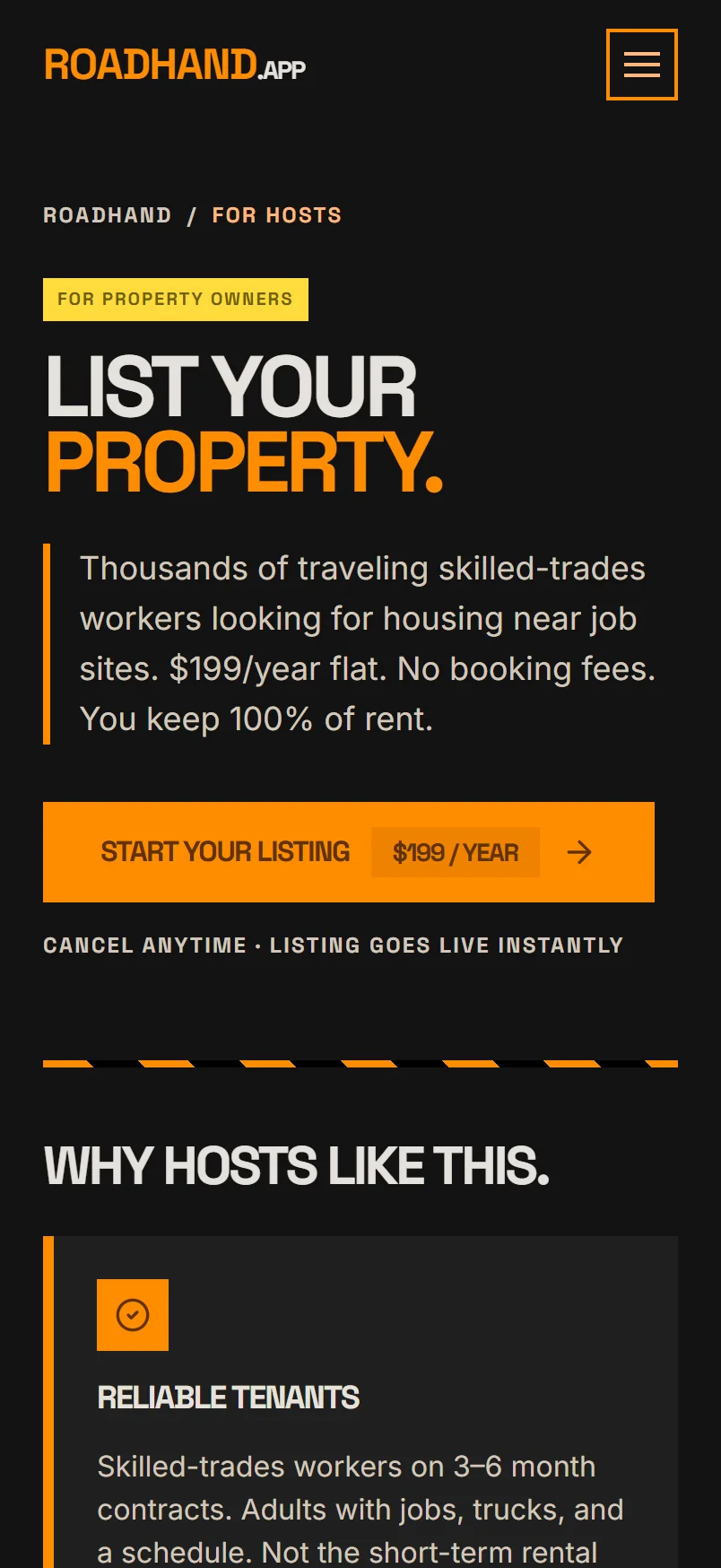
04The paid side. A listing is $199 a year, no commission, no booking fees.
Why I built it
Traveling trades workers make $150K decisions with zero information. They commit to a contract (pay, location, contractor, housing) before they have any data on whether any of it is good. The industry runs on word of mouth, Facebook groups, and guesswork. The cost of bad information lands on the worker; the existing platforms don't care.
The asymmetry is fixable. The federal government already publishes most of the data the worker needs (BLS wages, OSHA enforcement, Davis-Bacon prevailing wages, GSA per diem rates) and nobody had compiled it into something a worker could actually use.
What shipped
A full-stack two-sided marketplace, zero to production in a single dev sprint:
- A wage page for every trade in every state on real government data: 17 trades across 50 states and DC, with roughly 850 of them indexed.
- 4,850 BLS wage records, 4,171 Davis-Bacon wage determinations, 346 GSA per diem city records seeded from federal sources.
- Automated content engine generating data-driven articles from the government dataset: n8n workflows + Claude API + a Postgres content registry preventing duplicate generation.
- Paid host portal with Stripe integration: $199/year recurring subscriptions, webhook-driven subscription lifecycle, Customer Portal for self-serve cancellation.
- Dynamic OG images, JSON-LD structured data, and sitemap generation: every wage lookup, contractor profile, and housing page is server-rendered and indexable.
How the pieces fit: the federal data is the cold start, the workers and hosts add to it, and the pages are the channel.
Stack
- Frontend. Next.js 14 (App Router), React, Tailwind CSS.
- Auth. Firebase Authentication (Google OAuth + email/password).
- User-generated data. Firebase Firestore (reviews, pay reports, housing, profiles).
- Government data. Supabase (Postgres) for BLS wages, OSHA inspections, Davis-Bacon rates, GSA per diem.
- Payments. Stripe Checkout + Customer Portal + webhook subscription lifecycle.
- Hosting. Vercel with ISR for SEO pages.
- Content automation. n8n + Claude API + Postgres content registry.
- Design system. "Iron Asphalt": dark mode, 0px border radius, safety-orange accents, Space Grotesk + Inter.
Built solo with Claude as a daily collaborator across every layer: schema design, the content automation pipeline, the Stripe webhook flow, the SEO posture, the design system itself. The split-database architecture was a 30-minute call in a pair session: fast writes and offline support on Firestore for user content, complex joins and percentile math on Postgres for federal data. One conversation, two systems, both correct.
Key design decisions
- Government data as cold-start solution. Most review platforms launch empty and beg the first user to contribute. RoadHand launches with 500K+ federal data points already loaded. A worker gets value before a single review is submitted.
- SEO-first acquisition. The content is the channel. "Electrician pay North Dakota" ranks on Google; the worker arrives on the platform organically. No paid acquisition until the SEO floor is real.
- Platform, not party. RoadHand never touches rent payments, employment agreements, or contractor relationships. Protects the business legally and keeps the platform neutral.
- Workers free. Hosts pay. Workers use the platform free, always. Property hosts pay $199/year flat: no commission, no booking fees. Future monetization: premium worker features, staffing company partnerships, featured contractor listings.
How a Road Score is built
A worker who has finished a contract rates the place on nine things. The score is a weighted composite of those ratings across every review, and the weights say what matters most to someone deciding whether to take the job: how the place is overall, then what it costs to live and whether there is anywhere to sleep, then the rest.
The design system
Iron Asphalt. The rule the whole system follows: precision instrument manual, not startup landing page. OSHA placards, blueprint markup, equipment serial plates.
- Dark mode only. Asphalt behind everything, HiVis orange for the one thing that matters on a screen. Safe green, caution yellow and error red mean what they mean on a site.
- 0px corners, no soft shadows, caution-stripe dividers. The chrome looks like equipment, not a card deck.
- Headlines shout. All caps, tight, sentence fragments with periods: "KNOW BEFORE YOU GO." Eyebrows read like module IDs. Body copy stays sentence case, speaks to you, and calls trades by their names.
- Space Grotesk for the shouting, Inter for the reading, a mono for the labels. Lucide icons. No emoji.
The system lives in the product's own styleguide route, every primitive rendered from the real tokens, and it is packaged as an agent skill, tokens, rules and the kit together, so a new RoadHand surface starts on-system whether a person or an agent builds it. The kit itself is here, running: open the design system →
 The styleguide route, as shipped. Buttons, inputs, and the tonal cards, all from the real tokens.
 Badges for safety and market position, filter chips for trades and amenities, and the caution stripes that divide every section.
Why this matters
RoadHand is the studio venture that demonstrates the operating model (solo founder, Claude as daily collaborator) at full surface area: marketplace economics, federal-data ETL, content automation, paid SaaS billing, full SEO posture. Every layer was built and shipped by one person, in one continuous build.
The discipline isn't "AI replaces the team." It's the operating model collapses to one person with the right kit. That kit (opinionated agent primitives, the design discipline from a decade of design engineering, Claude in the loop on every layer) is what I bring to a team, whether it is one I build or one I join.